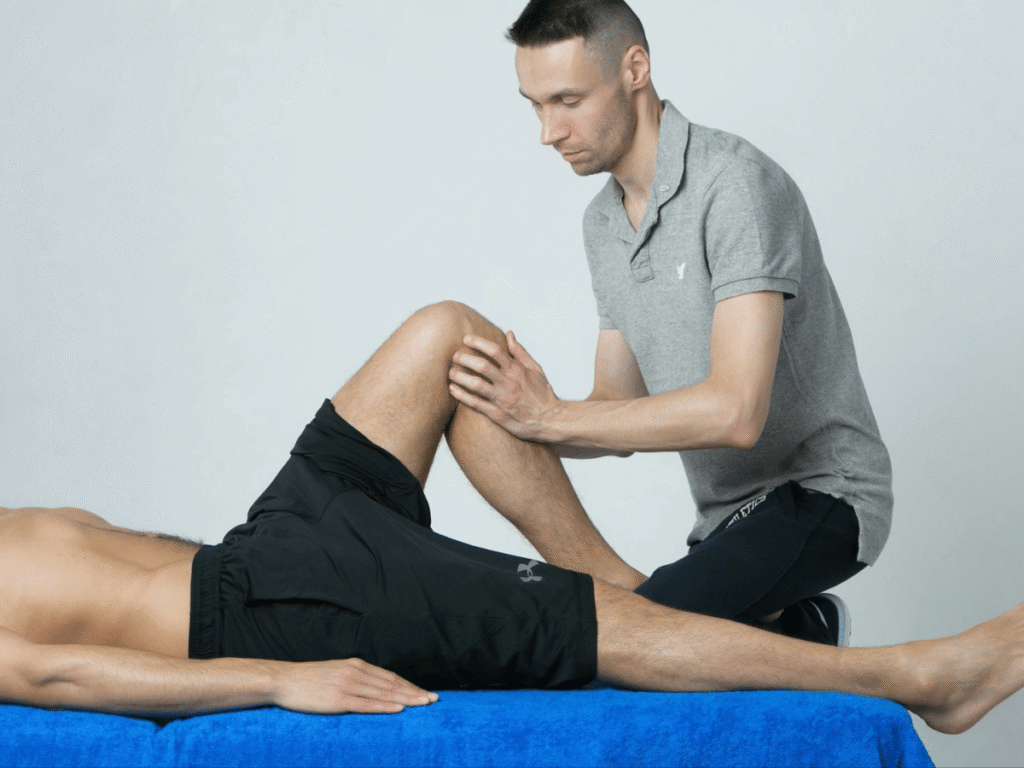
Recovery after an injury or surgery rarely follows the schedule that a patient’s imagination draws. Between “it no longer hurts” and “I can train again” lies a long, structured process managed by a separate, specially trained professional. In this article, we will explain exactly what a physical therapist does and how their work accelerates the return to a full life.
Understanding the Clinical Framework and Assessment Process of Mobility Experts
Any competent rehabilitation begins not with exercises, but with an assessment. At the first appointment, the specialist gathers the anamnesis, studies the mechanism of the injury, and observes how the patient moves, looking at gait, joint amplitude, and compensations that the body has built around the pain. Already at this stage, an experienced clinician often sees more than an MRI scan shows, since the image fixes the structure, whereas the examination reveals the function.
A standard primary assessment typically includes:
- Gathering medical history and clarifying the patient’s goals;
- Functional tests of strength, balance, and amplitude of movements;
- Analysis of movement patterns in everyday and sports tasks.
The obtained data turns into a measurable starting point to which the team returns at each follow-up examination. Progress ceases to be a sensation and becomes a figure: degrees of amplitude, kilograms in strength tests, or seconds in balance trials. Despite the seeming routine, it is these diagnostics that determine whether the treatment plan will be a hit on target or shoot blindly.
Comprehensive Educational Overviews Outlining the Core Role of Physical Therapist Practitioners
The profession is often perceived simplistically as a person showing exercises and making sure you perform them. The reality is noticeably more complex, and the best way to see this is to look into the educational materials about the role of a physical therapist on the Jooble website, which we recommend for reading, where daily duties, key skills, and career trajectories of specialists are laid out on the shelves.
The path into the profession in the US is long, including a Doctor of Physical Therapy degree, the NPTE licensing exam, and often additional specialisation in orthopaedics or sports rehabilitation. In other words, in front of you is not a trainer with weekend courses but a clinician with years of academic preparation behind them.
The scale of the profession is well illustrated by the labour market. It is enough to open the Jooble website, where up to a million users look for work daily, to evaluate how many job opportunities are open in the rehabilitation sphere. The platform covers 66 countries, stores around 9 million vacancies, and is replenished by 300,000 fresh offers daily.
Designing Targeted Treatment Plans for Accelerated Tissue and Joint Healing
When the picture is clear, the design begins. A competent treatment plan considers the phases of tissue healing, inflammation, proliferation, and remodelling. Loading a ligament in the second week, the same way as on the tenth, is a sure way to roll back progress; that is precisely why the dosing of the load is written out almost by the day.
At the same time, the plan is not dogma but a living document. The specialist tracks the tissue reaction after each session and adjusts the intensity, considering pain, swelling, and movement quality. Such control reduces downtime typical for independent rehabilitation, when a person either overloads the damaged area or babysits it for months. The patient with this approach always understands what stage they are at and what milestone opens the next level of load, from walking without support to returning to running.
Utilising Manual Therapy Techniques and Progressive Resistance Exercises
Hands remain the main tool of the profession. Manual techniques reduce pain syndrome and return mobility to joints, preparing the body for the next step, progressive resistance. The essence of the method is simple: the load grows in small steps, forcing tissues to adapt without crashing into a new inflammation. The arsenal of approaches here is noticeably wider than it seems from the outside:
| Method | Primary target | Typical recovery stage |
| Joint mobilization | Stiff capsules and a limited range of motion | Early to mid |
| Soft tissue release | Muscle guarding and adhesions | Early |
| Isometric loading | Painful tendons that cannot tolerate movement | |
| Eccentric training | Tendon remodelling and load capacity | Mid to late |
| Blood flow restriction training | Strength gains with light external loads | Mid |
The choice of a specific combination depends on the diagnosis, age, and even profession of the patient, because an office worker and a marathon runner need different readiness thresholds. Moreover, methods are rarely applied in isolation; manual work opens the amplitude, and power work secures it as a new motor skill. A tissue that was stretched but not loaded will return to its former state in just a couple of days, and a good clinician builds the session with an eye on this pattern.

Empowering Patient Autonomy Through Customised Home Recovery Protocols
An hour in the clinic by itself decides little if the remaining 167 hours of the week work against recovery. That is precisely why the final task of the specialist is to teach the patient to manage the process independently. The home protocol typically covers several directions:
- Dosed exercises with clear criteria for progression;
- Ergonomic adjustments and activity modification, which include optimising the home or work environment and teaching safe movement patterns for daily tasks (like lifting objects or sitting at a desk) to prevent aggravating the injury;
- Monitoring of sleep, steps, and overall daily activity;
- Adjustment of nutrition to the tasks of tissue recovery.
The last point is often underestimated, although protein, microelements, and anti-inflammatory nutrients directly affect the speed of healing. For those who are looking into supplements, the review of the benefits of Rosabella’s Moringa Powder Capsules will be useful as a plant source of calcium, magnesium, and flavonoids supporting joints, bones, and muscles.
Regular follow-up visits do not disappear anywhere at the same time; however, their role changes. The specialist checks the technique, updates the protocol, and filters out bad habits before they take root. One way or another, patient autonomy is not a side effect of therapy but its main result. Thus, a physical therapist accelerates recovery not by the magic of hands, but by a system, an accurate assessment, a verified load, and a gradual transfer of control into the hands of the person themselves.